



Ransomware Prevention for Manufacturers in Seattle: Protect Production and Data
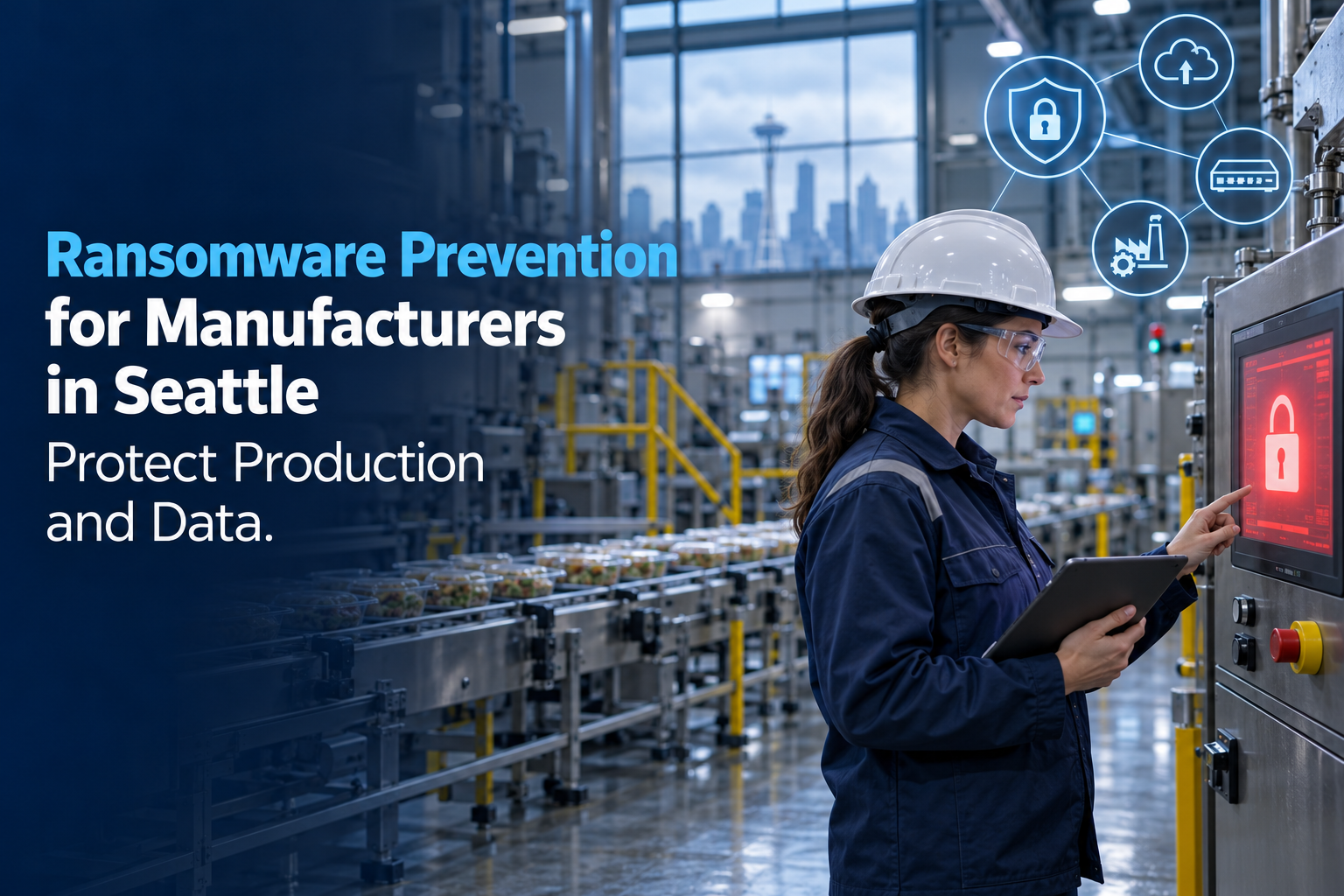
Your line is running. Then an HMI freezes, a conveyor stops, and a message asks for payment. Ransomware is no longer an office-computer problem. It is a production problem, and every idle hour costs orders, overtime, and customer trust.
For manufacturers in Seattle, ransomware prevention starts with one honest question: if the office network were hit tonight, would the plant floor keep running tomorrow? As your local IT company, we help IT services for manufacturing firms in Seattle answer that question before an attacker does.
How Ransomware Stops Production on the Plant Floor
Ransomware is malicious software that locks or encrypts data and systems until a ransom is paid. In manufacturing, attackers increasingly aim at operational technology (OT), the systems that run the machines.
- Programmable logic controllers (PLCs) and human-machine interfaces (HMIs) can freeze, which stops equipment mid-run.
- Supervisory control and data acquisition (SCADA) and manufacturing execution systems (MES) can be locked, so no one can see or schedule production.
- Downtime piles up as spoiled material, missed shipments, and rush costs.
- Disabled automation can also create safety hazards for people working near machinery.
Many plants in the Puget Sound area run older equipment that was never designed with security in mind. That makes a plan for preventing ransomware in manufacturing more urgent, not less.
Why Standard IT Security Falls Short in Industrial Environments
Office-grade protection helps, but a plant floor behaves differently.
- Unsupported software. HMIs and PLCs often run on versions that no longer receive patches.
- Assumed isolation. A network described as “air-gapped” often still connects through vendor remote access or maintenance laptops.
- Blind spots. Generic antivirus and basic network monitoring may not recognize attacks aimed at industrial protocols.
Effective ransomware protection for manufacturers treats IT and OT as one risk. Attackers do not respect the boundary between the front office and the shop floor.
What Manufacturers Around Seattle Are Up Against
Manufacturing around Seattle is varied. Aerospace suppliers, food and beverage processors, marine and metal fabricators, and distribution operations cluster across the Duwamish industrial area, SoDo, Georgetown, and the Kent Valley. Each runs differently, but they share three pressures.
Tight delivery windows come first. A supplier feeding a larger production schedule has little room for a lost shift. Second, many shops depend on a small IT footprint, sometimes one person or an outside provider covering everything from email to the plant network. Third, customers and insurers increasingly ask manufacturers to show how they protect data and recover from an attack.
None of this requires a large security department. It requires a clear map of what you run, sensible separation between networks, and recovery you have actually tested.
Six Steps for Ransomware Prevention in Manufacturing
Federal guidance points in the same direction. CISA’s #StopRansomware Guide covers prevention and response, and NIST’s SP 800-82 Rev. 3 addresses OT security. NIST’s IR 8374 ransomware risk management profile helps teams organize the work. These steps follow the same logic.
- Map critical systems. List every PLC, HMI, SCADA server, MES node, and connected workstation, with firmware versions, dependencies, and network paths. You cannot protect what you have not documented.
- Segment IT and OT networks. Keep production networks apart from office systems and control the few connections that must exist. Firewalls and VLANs help stop an infected office PC from reaching a controller.
- Back up both sides, and test the restore. Back up IT and OT systems, keep copies offline or in a protected cloud location, and rehearse recovery. See how our backup and disaster recovery work supports this.
- Patch with a plan. Schedule updates and firmware changes around production. A planned pause usually costs less than an unplanned stop.
- Train people and limit access. Most attacks begin with a phishing email or a stolen password. Our phishing training helps teams spot them, and least-privilege access limits how far an intruder can travel.
- Monitor and respond. Around-the-clock monitoring helps catch unusual activity early. Our cybersecurity services monitor multiple layers of hardware and security and can block access when suspicious activity is detected.
How We Support Manufacturers in Seattle
We have supported manufacturers for 15 years, and we are a partner of the Center for Advanced Manufacturing Partnership (CAMPS). As a Cisco Meraki certified provider, we are comfortable with the network design that segmentation depends on.
- Around-the-clock monitoring is built to help prevent issues before they become downtime.
- Business data and intellectual property are protected through monitoring, secure backups, and access control.
- An after-hours emergency line means a problem on the second shift is not left waiting for morning.
- A free IT security assessment gives you a written view of where your network stands today.
Where plants run PLCs, HMIs, or SCADA, we start by confirming what the environment requires and coordinate with your equipment vendors to ensure they run in a secure environment.
A Scenario Worth Planning Around
Picture a mid-sized food processor in the Seattle area. Overnight, a phishing email opens the door to an office workstation. With no separation between office and plant networks, the infection reaches the HMIs, and conveyors stop with product still on the line.
Now picture the same plant with segmented networks, tested backups, and monitoring that flags the unusual traffic. The office is disrupted, but the line keeps moving. This is a hypothetical example, not a client story, but it shows why the order of the six steps matters.
Schedule a Free IT Assessment for Your Plant in Seattle
Ransomware prevention is not a product you buy once. It is a set of habits, backed by a partner who answers when something looks wrong. If you want to know where your plant stands, schedule a free IT assessment or call us at (425) 249-3978. Our team in Seattle works with manufacturers across the region, onsite and remotely.
For a broader view of how we support plants and warehouses, see our managed IT services.
Frequently Asked Questions About Ransomware Prevention for Manufacturers in Seattle
It is the set of steps that keep ransomware from reaching production systems, or limit the damage if it does. We combine network segmentation, tested backups, patching, access control, and monitoring so manufacturers in Seattle can keep running.
Yes. When ransomware reaches HMIs, PLCs, or the servers that run them, equipment can halt even if the machines themselves are undamaged. Our ransomware prevention work focuses on keeping an office incident from spreading to the plant floor.
Not by default. Vendor remote access, maintenance laptops, and USB drives often bridge the gap. We review these connection points as part of ransomware prevention for manufacturers.
Segmentation separates office systems from production systems and limits which devices can talk to each other. If one side is compromised, the other has a better chance of staying online.
It depends on how often your data and configurations change and how quickly production must recover. We set a testing schedule around your plant, then confirm that a restore works before you need it.
Many customers and insurers now expect documented security controls. Stronger ransomware protection can make those conversations easier, and we can help you gather the documentation. Talk with your insurance advisor about coverage details.
Disconnect affected systems from the network, avoid paying or contacting the attacker until you have advice, and call us right away. Our after-hours emergency line exists for this situation, and CISA’s guide outlines response steps worth having on paper in advance.

Recent Posts


How can we help?
Whether you need immediate help with an IT issue or want to discuss your long-term IT strategy, our team is here to help.
Call us at 425-249-3978 or complete the form below and we'll help in any way we can.